Why Does Everything With My Ex Turn Into a Fight?
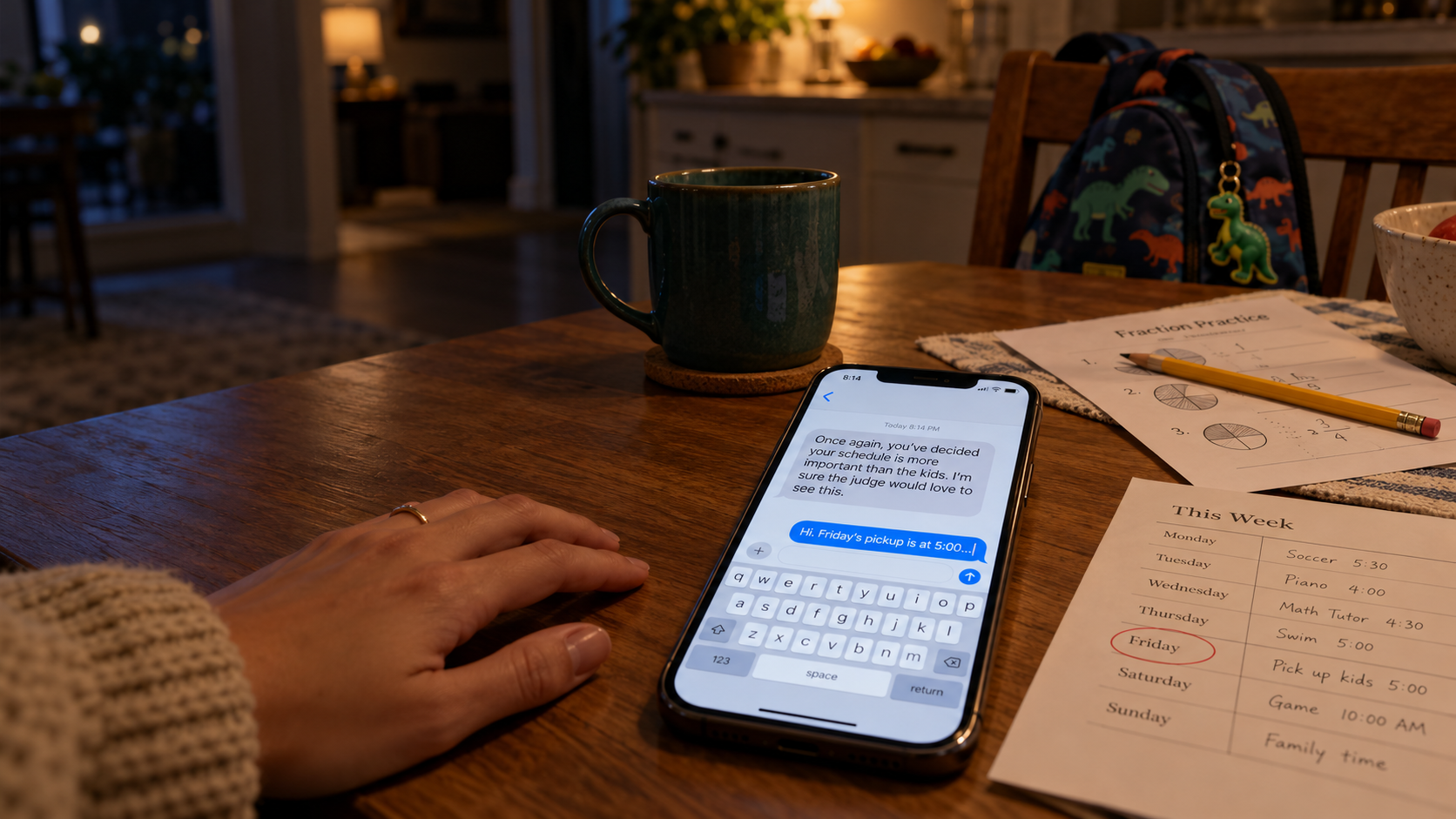
When every conversation becomes an argument, the problem may not be what you’re saying. It may be the pattern you’re caught in.
Est. Reading time: 4 mins.
You asked a simple question about Friday’s pickup time. Twenty minutes later, you’re defending something you said eight months ago, you’ve been accused of keeping the children away, and you’re staring at a message that has nothing to do with Friday. So you scroll back, trying to find where it went sideways. Maybe you sounded demanding. Maybe you should have said less, or more.
You’ve probably been told to communicate better, compromise, and put the children first. But what happens when you’ve tried all of it and nothing changes?
When Normal Conflict Resolution Doesn’t Work
Most of us walk into a disagreement assuming both people want it resolved, even if they disagree about how. You find some middle ground and move on.
In some high-conflict relationships, that assumption doesn’t hold. A request for clarification becomes an accusation. A compromise becomes the starting point for a new demand. The agreement you reached on Tuesday is disputed by Thursday. Sometimes that comes from raw emotions or mismatched expectations, which can ease with time. Other times it’s a persistent pattern of blame, control, or an unwillingness to accept limits, and that pattern doesn’t respond to better wording. The difference matters, because strategies that work in an ordinary disagreement can backfire in a high-conflict one. You can’t cooperate your way out of a problem when cooperation isn’t a shared goal.
Why Explaining Yourself Can Make Things Worse
Say your ex sends this:
“Once again, you’ve decided your schedule is more important than the kids. You never think about anyone but yourself. I’m sure the judge would love to see how difficult you’re being.”
Your instinct is to defend yourself. You explain that the schedule was agreed on weeks ago, that you’ve accommodated changes before, that the kids have an activity. Every word of it may be true. But now you’re defending your character instead of answering a scheduling question, and not every accusation is a question that needs an answer.
Three ways you could respond:
Okay Response: Explaining
“We agreed to this schedule three weeks ago, and I’ve already changed my plans twice to accommodate you. I’m not trying to make things difficult. The kids have an activity on Friday, and I’m just trying to keep things consistent.”
It’s reasonable, and it hands your ex four new points to dispute.
Better Response: Redirecting
“The schedule we agreed on has Friday’s pickup at 5:00 p.m. The kids have an activity beforehand, so I’d like to keep that arrangement.”
This one stays on the actual issue, but it still frames the schedule as your preference, which invites a debate about preferences.
Best Response: Informing
“Hi. Friday’s pickup is at 5:00 p.m. at school, per our schedule. If you’d like to request a change, please let me know by Thursday at noon. Thanks.”
No defense, no argument, no extra explanation. Just the relevant facts, a clear next step, and enough courtesy to keep the temperature down. It gets the job done without creating new openings for conflict, and it’s the kind of message you’d be comfortable having a mediator or judge read someday, which in a high-conflict case is a real possibility.
This approach follows the BIFF® Response method developed by Bill Eddy of the High Conflict Institute: Brief, Informative, Friendly, and Firm. It won’t guarantee cooperation. It may save you another evening spent arguing about something that was never the issue.
Boundaries Are Not Rules
Another common frustration sounds like this: “I’ve told my ex a hundred times they can’t talk to me like that. Why won’t they respect my boundaries?”
Because telling someone how they can and can’t behave is a rule, not a boundary. A rule tries to govern someone else’s behavior. A boundary governs your own.
A rule sounds like “You cannot speak to me disrespectfully.” A boundary sounds like “I’ll respond to messages about the children and scheduling. I won’t respond to personal insults.” The first only works if the other person complies. The second describes what you’ll do whether they comply or not.
You may not be able to stop hostile messages, but you can decide which parts need your attention, how you’ll respond, and when you’ll step away. Your boundaries still have to work within your court orders and make room for real emergencies. The point is to stop letting every provocation decide how much of you it gets.
Sometimes You Need Better Systems, Not Better Words
If you’ve spent months rewriting messages, it may be time to look past communication altogether. Do the same disputes keep coming back? Are your agreements vague? Does every schedule change turn into a negotiation? Do you make exceptions to keep the peace, only to watch them become new expectations?
Those are structural problems. A detailed parenting schedule, a clear procedure for requesting changes, defined decision-making responsibilities, and a single communication platform all shrink the list of things there are to fight about. For some families, a parallel parenting arrangement that keeps interaction to a minimum works better than expecting regular collaboration. The goal isn’t a perfect relationship with your ex. It’s a framework that doesn’t require extraordinary conflict to make ordinary parenting decisions.
One important exception: if threats, intimidation, coercive control, or abuse are part of the picture, communication strategies are not enough, and your safety comes first. Reach out to law enforcement, an attorney, or a domestic violence advocate. The National Domestic Violence Hotline is available 24/7 at 1-800-799-7233.
You Don’t Need to Diagnose Your Ex
Sooner or later, many people go looking for a label. Narcissist. Borderline. High-conflict personality. Gaslighting. Understanding behavioral patterns can help, but diagnosing your ex from an internet checklist won’t solve Friday’s pickup, and you don’t need a diagnosis to see that something keeps not working.
The more useful questions are practical ones. What keeps happening? What sets off the same arguments? Which decisions actually require the two of you to interact, and which could be handled by a set procedure? When does an issue need your attorney or another professional?
Getting Your Life Back
One of the crueler parts of long-running post-separation conflict is how much room it takes up. The relationship is over, but your attention is still tethered to it. You check your phone with dread and rehearse arguments that haven’t happened, while there are children to raise, bills to pay, and a life you’re trying to rebuild. You shouldn’t have to become an expert in conflict management just to get through an ordinary Tuesday.
That’s the work a High-Conflict Divorce Coach, sometimes called a family conflict consultant, does with you: recognizing the patterns, building responses and systems that hold up, and sorting out which issues belong with your attorney. Progress doesn’t always mean your ex stops creating conflict. Sometimes it means the conflict stops running your life.
Before the Next Message
Try this the next time a message from your ex lands: before you reply, find the one question in it that actually needs an answer, if there is one. Answer that, and only that. Everything else can wait, and much of it can go unanswered entirely.
If you’d like a way to make that call in the moment, I’ve put the questions I walk clients through onto one page: Before You Respond: A High-Conflict Triage Sheet. Save it to your phone. It’s for the next time your heart is pounding and your thumbs are already typing.
About the Author
Charliana Michaels is a High-Conflict Divorce Coach and the founder of Cerberus Family Solutions in North County San Diego. She is a CDC®, Certified High-Conflict Mediator, and Certified Co-Parenting Specialist, with a degree in psychology and years spent studying how conflict patterns repeat. She helps clients stop answering every accusation and start building systems that make the next fight less likely.