What Happens In Court Stays in Court
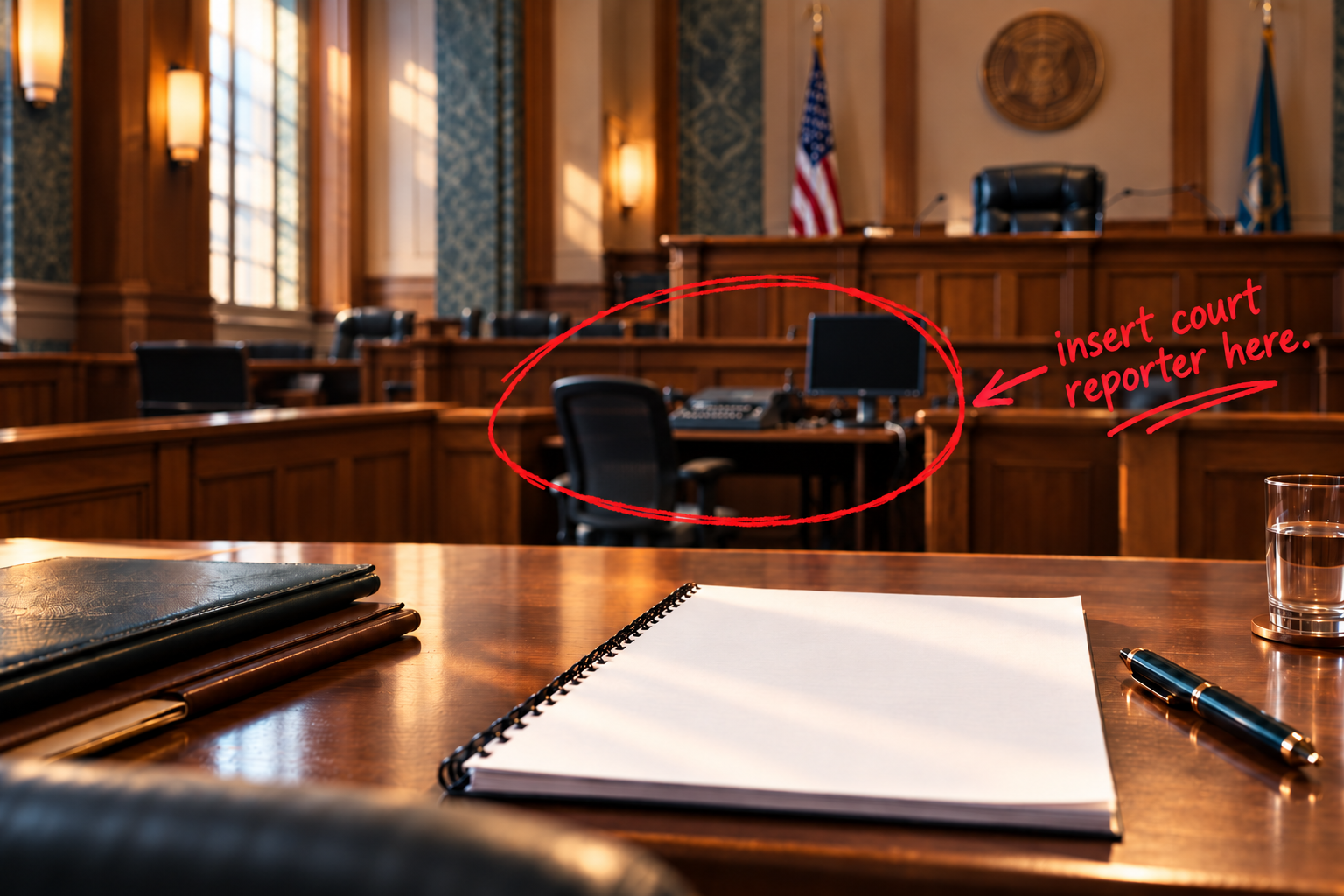
You can be wronged, be right about it, and still have no way to fix it.
Here's why, and the one question to ask before your next hearing.
Most people believe an appeal is a safety net. If the judge gets it wrong, a higher court looks at the case again and fixes it. It's a reasonable belief, and it's part of why we accept a family court judge's authority over our children, our homes, and our money in the first place. In a growing number of California cases, it is also not true in any practical sense.
A client of mine learned this recently, and expensively. After a support hearing my client believed was decided wrongly, they consulted a couple of appellate attorneys. Both agreed the judge had made a legitimate error. Then they asked a single question: was there a court reporter at the hearing?
There wasn't. No one asked if they wanted one. It wasn't even on their radar.
From that moment, the conversation stopped being about whether my client was right and started being about whether my client could prove it. Those turned out to be very different questions.
An appeal is not a do-over
The Court of Appeal doesn't hear witnesses, take new evidence, or decide who seemed more credible. It reviews the record, meaning the official account of what happened in the trial court, and almost nothing else. It begins by presuming the trial judge got it right. The burden is on the person appealing to prove otherwise, using that record, and where the record is silent, the appellate court fills the silence in the judge's favor.¹
Now consider what a hearing without a reporter leaves behind: the papers filed beforehand and the order that came out afterward. Everything in between (the testimony, the objections, the misleading statements from opposing counsel, the judge's reasoning from the bench, the exact moment the judge misunderstood the evidence) exists only in the memories of the people who were in the room. Your memory is not a record. Neither is your attorney's.
This isn't hypothetical. In a 2025 published decision, In re Marriage of R.K. & G.K., a father appealed after going from sole physical custody of his daughter to none, following a three-day hearing no one transcribed. The opinion states, in multiple sections, the problem in four words: "There is no record here." With nothing to show what was said over those three days, the court presumed the evidence supported every one of the trial judge's findings, and affirmed.¹ The trial court's findings against him were harsh, and he may well have deserved the outcome. The appeal can't tell us, because there was nothing for the appellate court to check.
The math of being right
My client's appellate attorneys were candid. Without a transcript, an appeal would first require reconstructing the hearing through a settled statement, a written summary of the proceedings that must be approved by the trial judge.² The same judge whose ruling is being challenged. They estimated a minimum of $25,000 and a year or more of litigation.
And winning wouldn't necessarily mean “winning.” When an appellate court finds error in a discretionary family-law ruling, the remedy is often a remand: the case goes back down to the trial court to be decided again. For my client, the realistic best case after a year and $25,000 might be a revised support order roughly $300 a month different. Or a new ruling that lands exactly where the old one did.
Meanwhile, the order doesn't wait. Filing an appeal does not pause a custody or visitation order, and an order to pay money generally stays enforceable unless the appealing party posts a bond.³ You live under the ruling you're challenging for as long as the challenge takes.
So the question my client faces is no longer "Was I wronged?" Two appellate specialists answered that. The question is "Can I afford to prove it, and is the proof worth what it costs?" Our system quietly treats those as the same question. They are not.
Nobody asked
Here is the part that should stop every litigant, and every attorney, cold.
My client had an attorney. The judge was a known obstacle. Opposing counsel was a known high-conflict litigator. Every signal pointed toward a hearing that might need to be reviewed later. No one arranged for a court reporter, because no one asked, and my client didn't know there was anything to ask.
Most people assume court hearings are recorded, the way they are on television. In California family court, they frequently aren't. Courts are short on official reporters and assign the ones they have to higher-priority matters like felony cases. State law has also long barred courts from using electronic recordings as the official record in family, probate, and civil cases.⁴ The practical result: if you want a verbatim record of your family-law hearing, you often have to hire and pay a private reporter yourself. The Judicial Council estimates the average cost at about $3,300 per day for trial.⁵
Between April 2023 and March 2026, more than three million family-law, probate, and civil hearings in California, roughly seven in ten, took place with no verbatim record at all.⁵
Three million hearings where the right to appeal exists mostly in theory.
In August 2026, the California Supreme Court confronted this directly. In Family Violence Appellate Project v. Superior Court, a unanimous court held that trial courts must give litigants who can't afford a private reporter meaningful access to an official verbatim record, including electronic recording when no reporter is available. Chief Justice Guerrero wrote that the earlier promise of a record for low-income litigants had "proven illusory."⁴
It is an important ruling. It is also a narrow one. It protects litigants who cannot afford a reporter, and only if they ask. It does nothing for the many people in the middle who could have paid for a reporter if anyone had told them they needed one.
Ask This:
Before any hearing that matters (and in a high-conflict case, assume they all might):
"Will there be a court reporter, and who is arranging it?" Ask days ahead, not at the courtroom door, and get the answer in writing.
"If I can't afford a reporter, how do I request an official record from the court?" Courts now have a duty to provide one for litigants who can't pay.⁴ If you're representing yourself, start with the court's self-help center.
"If this hearing goes wrong, what will we have to show for it?" If the honest answer is "just the order," decide now whether you can live with that.
Already had a hearing without a reporter? Ask your attorney about a settled or agreed statement immediately. Both have deadlines.²
To the attorneys reading this: your clients don't know to ask. That isn't a criticism; it's the gap. Raising the reporter question at intake, and again before every contested hearing, takes one sentence. Skipping it can cost your client an appeal before anyone knows they need one.
The Bottom Line
A right to appeal is only as real as the record behind it. We spend enormous energy arguing about what the record shows. First, make sure there is one.
Sources
In re Marriage of R.K. & G.K. (2025) 113 Cal.App.5th 14.
Cal. Rules of Court, rules 8.134 (agreed statement) and 8.137 (settled statement).
Code Civ. Proc., § 917.7 (appeal does not stay custody/visitation provisions); § 917.1 (money judgments not stayed absent undertaking).
Gov. Code, § 69957; Family Violence Appellate Project v. Superior Court (2026) 20 Cal.5th 564.
Judicial Council of California data on hearings without a verbatim record, April 2023 to March 2026, and private reporter cost estimate, as reported by Law360/MLex (2026) and Bay Area Legal Aid, Court Reporter Shortage FAQ.
Charliana Michaels is the founder of Cerberus Family Solutions, where she coaches clients through high-conflict divorce and prepares them for the hearings that matter most, including the questions they don't yet know to ask. She is a Certified Divorce Coach (CDC®), Certified High-Conflict Mediator, family law paralegal, and California-registered Legal Document Assistant. If you have a contested hearing coming up, talk to her before the court date, not after.